
Table of Contents
- What Actually Separates High Quality Herbal Tea From the Rest
- How to Read an Herbal Tea Label (and Spot Synthetic Flavorings)
- Loose Leaf vs Tea Bags: Which Format Fits Your Routine?
- What Organic Herbal Tea Certification Really Means
- How to Brew Herbal Tea Properly for Better Flavor
- Herbal Tea Storage Tips to Protect Flavor and Freshness
- Red Flags: Signs of Low-Quality Herbal Tea to Avoid
- Frequently Asked Questions
Last Updated: September 27, 2026
What Actually Separates High Quality Herbal Tea From the Rest
Learning how to choose high quality herbal tea comes down to one thing: what's actually inside the bag or tin. Most shoppers scan the front of the box, see the word "wellness," and toss it in the cart. That's exactly how you end up with a cup that tastes like hot water and disappointment.
Whole Botanicals vs. Dust and Fannings
Whole leaf and whole botanical pieces brew into a fuller, more complex cup. Broken bits, called fannings and dust, release flavor fast but fade quickly and often taste flat or bitter. Look for recognizable pieces: whole chamomile flowers, intact mint leaves, visible chunks of dried fruit or root.
Why Origin Transparency Matters
A package that names where its ingredients grew tells you the maker is proud of them. Origin transparency is one of the clearest signals of a serious herbal tea brand, because sourcing regions affect flavor, aroma, and handling after harvest. Vague labels that say only "imported" usually have something to hide.
How to Read an Herbal Tea Label (and Spot Synthetic Flavorings)
The ingredient list is where quality is won or lost. Read it before you read anything else on the box.
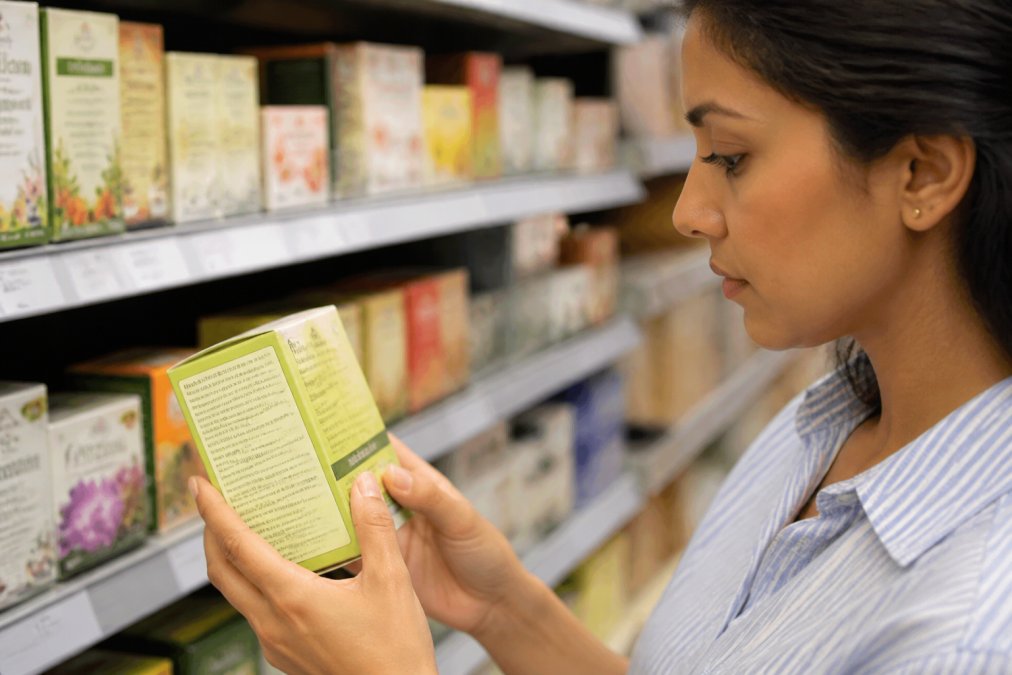
Watch for these red flags on a label:
- "Natural flavors" or "flavoring" high in the list, which often signals synthetic flavorings rather than real botanicals
- Added sugars, syrups, or maltodextrin, which bulk up weight and mask weak ingredients
- No harvest date or lot number, making it impossible to judge freshness
- "Spices" or "herbal blend" with no breakdown, which hides what's actually inside
What a Harvest Date Tells You About Shelf Life
A printed harvest date is the single most useful number on an herbal tea package. Dried botanicals lose their aromatic compounds over time, so a recently harvested tea will smell brighter and taste fuller than one that's been sitting in a warehouse. If a brand won't say when its ingredients were picked, that tells you something.
The Label Detail Most Guides Skip: Third-Party Testing
A clean ingredient list tells you what's in the tea. It doesn't tell you what else might be in it. Botanicals are agricultural products, and they can carry heavy metals, pesticide residue, or microbial contamination depending on where and how they were grown.
- Which lab ran the test. Independent, accredited labs carry more weight than in-house testing.
- Which lot it covers. A COA should match the lot number on your package, not a generic sample.
- What was tested for. Heavy metals (lead, arsenic, cadmium), pesticide residue, and microbials are the core panel for dried botanicals.
Certifications Worth Knowing Beyond "Organic"
- Fair Trade Certified speaks to how farmers were paid, not to flavor or purity.
- Non-GMO Project Verified confirms the botanicals weren't genetically engineered.
- Rainforest Alliance Certified covers environmental and worker standards on farms.
At Dawterson, we ask our suppliers the same questions we're suggesting you ask: where did this grow, when was it harvested, and can you show us the paperwork. It's part of how we choose wellness products.
Loose Leaf vs Tea Bags: Which Format Fits Your Routine?
Loose leaf wins on flavor; tea bags win on convenience. The right pick depends on how you actually drink tea.
| Factor | Loose Leaf | Tea Bags / Sachets |
|---|---|---|
| Flavor depth | Fuller, more complex | Good to excellent in whole-leaf sachets |
| Convenience | Needs an infuser | Drop and go |
| Cost per cup | Usually lower | Usually higher |
| Best for | Slow rituals, multiple steeps | Busy mornings, travel, office |
What Organic Herbal Tea Certification Really Means
Organic herbal tea certification confirms that ingredients were grown without synthetic pesticides and processed under defined standards. In the United States, that claim is verified by the USDA National Organic Program, not by the brand itself.
How to Brew Herbal Tea Properly for Better Flavor
Here's the process we recommend:
Five Treasure Herbal Vitality Tea →
- Start with filtered water. Tap water with heavy chlorine or mineral content flattens delicate floral notes.
- Heat to the right temperature. Most herbal infusions want water just off a boil, around 200-212°F. Delicate florals do better closer to 200°F.
- Measure generously. Use about 1 teaspoon of loose herbs or one sachet per 8 ounces of water.
- Steep 3-5 minutes. Roots and spices need the longer end; flowers and leaves need less.
- Taste before you sweeten. Give the botanicals a chance to show their natural sweetness first.
If you want a blend that's already balanced for easy brewing, our Five Treasure Herbal Vitality Tea comes in individually portioned bags with a simple 3-5 minute steep, which takes the guesswork out of the process.

Herbal Tea Storage Tips to Protect Flavor and Freshness
Airtight storage is the difference between a tea that stays fragrant for months and one that goes flat in weeks. Oxygen, light, heat, and moisture are the enemies of dried botanicals.
- Transfer to an airtight container once the original package is opened, unless it reseals tightly on its own.
- Keep it dark. A cabinet beats a sunny countertop every time.
- Store away from the stove. Heat speeds up flavor loss.
- Skip the fridge. Condensation inside the container ruins dried herbs.
- Label the date. Write the harvest or purchase date on the lid so you know what's fresh.
Red Flags: Signs of Low-Quality Herbal Tea to Avoid
You can often judge a tea before you brew it. Trust your eyes and nose first.
A Visual Inspection Checklist You Can Use in the Aisle
Here's a practical checklist you can run in about thirty seconds:
- Color. Whole botanicals should look like what they were. Chamomile flowers should be pale yellow with visible petals. Mint should be green, not brown. Hibiscus should be deep crimson. Uniform gray-brown across every variety is a warning sign.
- Leaf and petal integrity. You want recognizable pieces, whole flowers, intact leaves, distinct chunks of root or fruit. If everything is the same size and looks like gravel, it's been over-processed.
- Dust content. Turn the bag or tin gently. If fine powder settles at the bottom, that's dust and fannings, which brew bitter and flat. A little is normal; a visible layer is not.
- Stems and filler. Some stem is unavoidable. A bag that's mostly stem with few leaves or flowers is padded weight, not quality.
- Aroma through the package. Even sealed, a good herbal tea should smell like something when you bring it close. If you get nothing, the aromatic oils are already gone.
The Packaging Problem Nobody Talks About
Here's a gap most buying guides leave open: the bag itself. If you're brewing in a conventional paper or mesh tea bag, you're steeping whatever that bag is made of along with your botanicals.
A few things worth knowing:
- Conventional sealed tea bags are often closed with heat and a small amount of food-grade adhesive. Most are fine, but some can contribute a faint papery or gluey note to delicate florals.
- Plastic mesh pyramid sachets are popular because they let leaves expand, but some are made from petroleum-based nylon or PET. At brewing temperatures, the concern is whether any material migrates into your cup. Research on this is still developing, and many consumers prefer to avoid the question entirely.
- Biodegradable and plant-based sachets, made from materials like cornstarch-based PLA or unbleached paper, sidestep the plastic question. They're increasingly common and worth seeking out if this matters to you.
- Loose leaf in a stainless steel or glass infuser avoids the packaging question altogether. It's the simplest answer if you want zero ambiguity.
Other Signs to Walk Away
- No aroma when you open the package. Fresh botanicals smell like something.
- Uniform brown dust instead of visible leaves, flowers, or fruit pieces.
- A price that's suspiciously low for a long list of exotic ingredients.
- Packaging that lists no origin, no harvest date, and no lot number.
- A flavor that tastes the same across every variety, which usually means heavy flavoring.
- No COA or testing information available on request.
If you'd rather skip the guesswork, our wellness collection is curated with these exact checks in mind, from whole-flower blends to sachets made with plant-based materials. Every order comes with our 30-day no-hassle returns, and shipping is free on orders $50 or more, so you can try something new without the risk.
Frequently Asked Questions
How can you tell if herbal tea is high quality?
Start with the ingredient list. High quality herbal tea names whole botanicals like chamomile flowers, peppermint leaf, or rose hips, not vague terms like 'natural flavors.' Check for a harvest or best-by date, look for large intact pieces instead of fine dust, and notice how the dry tea smells before brewing. Fresh, well-stored tea usually has a clear, bright aroma rather than a flat or dusty one.
Are loose leaf herbal teas better than tea bags?
Loose leaf gives leaves and botanicals more room to expand, which often means a fuller flavor and more room for multiple infusions. Tea bags win on convenience and easy cleanup. Many quality brands now offer whole-leaf sachets, which sit between the two. If you brew daily and want the best flavor per cup, loose leaf is worth the extra step. If speed matters more, look for bags that list whole ingredients rather than dust.
Does organic herbal tea certification actually matter?
It depends on what you want to avoid. In the U.S., the USDA Organic seal means ingredients were grown without synthetic pesticides and processed under specific standards. That matters most for herbs you drink often. If a tea is not certified organic, look for clear sourcing details and third-party testing information instead. Neither label guarantees flavor, so pair certification with a look at ingredient quality and freshness.
How should I store herbal tea to keep it fresh?
Keep tea away from light, heat, moisture, and strong odors. An airtight container in a cool, dark cabinet works well. Avoid storing tea above the stove or near a sunny window. If you buy in bulk, split it into smaller portions so you open the main supply less often. Most herbal teas taste best within six to twelve months of the harvest or best-by date, though proper storage can stretch that window.