
Table of Contents
- Why Daily Wear Compression Socks Are Worth the Switch
- The Benefits of Wearing Compression Socks Daily
- Compression Socks mmHg Guide: Finding Your Support Level
- How to Choose Compression Socks for Your Routine
- Sensory-Friendly and Seamless Options for Sensitive Skin
- When to Skip Compression Socks: Safety and Contraindications
- Conclusion
- Frequently Asked Questions
Last Updated: September 17, 2026
Why Daily Wear Compression Socks Are Worth the Switch
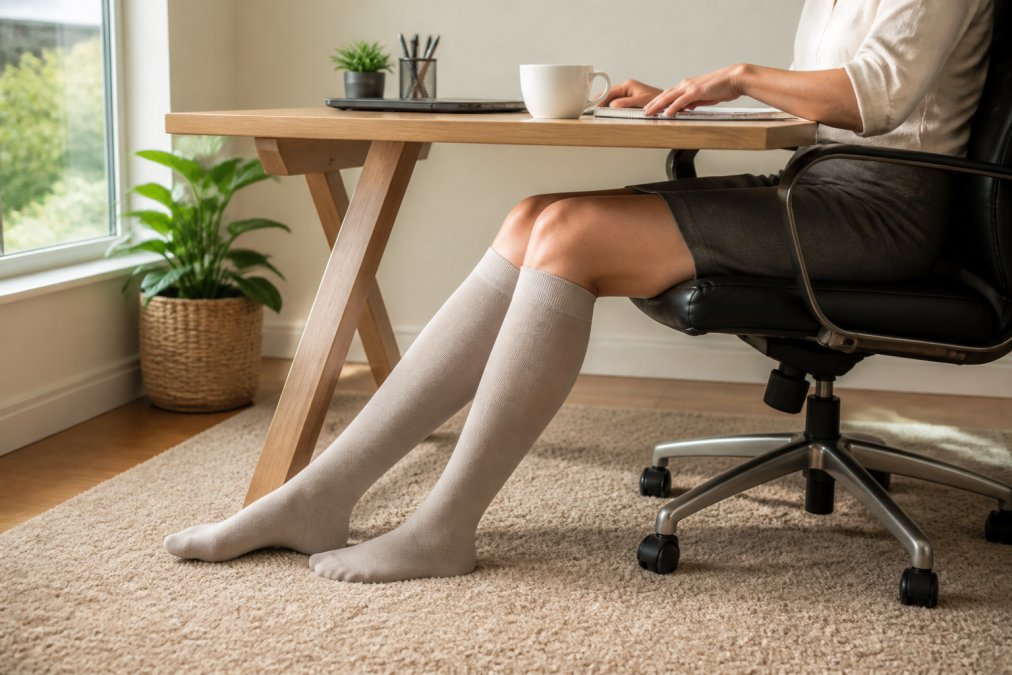
Compression socks are therapeutic hosiery that applies graduated pressure to your legs, tightest at the ankle and loosening up the calf, helping your veins push blood back toward your heart instead of letting it pool. The best compression socks for daily wear make that support feel effortless rather than medical.
The Benefits of Wearing Compression Socks Daily
The core benefit of daily compression is steady support for circulation during the hours your legs need it most.
Reducing Swelling and Leg Heaviness
Swelling, also called edema, happens when fluid collects in your lower legs after hours of standing or sitting. Graduated compression counters that with ankle pressure higher than at the calf. Many people who stand all day find their ankles look and feel less puffy by evening.
Supporting Circulation During Long Days
Circulation support matters most when you're stationary. Desk work, long drives, and standing shifts all slow the calf muscle pump that normally pushes blood upward. Compression socks give that pump a assist.
Compression Socks mmHg Guide: Finding Your Support Level
mmHg stands for millimeters of mercury, the unit measuring how much pressure a compression sock applies at a given point. The number on the label tells you the support level, and picking the wrong one is the most common mistake we see.
Here's how the levels break down:
| Support Level | Typical Use | Who It's For |
|---|---|---|
| 8-15 mmHg | Mild support | Travel, light swelling, first-timers |
| 15-20 mmHg | Moderate support | Daily wear, desk jobs, standing shifts |
| 20-30 mmHg | Firm support | Doctor-recommended, pronounced swelling |
| 30-40 mmHg | Medical-grade | Prescribed for specific conditions |
How mmHg Is Actually Measured
Compression is expressed as a range because pressure changes as the sock stretches over the leg. A 15-20 mmHg sock typically delivers about 20 mmHg at the ankle and tapers toward 15 mmHg at the calf, the range describes the spread between the two ends, not a uniform squeeze.
Reading the Label Without Getting Fooled
A few things to check before you buy:
- The mmHg range should be printed on the packaging or product page. If it says "20-30 mmHg" but the fine print says "graduated 15-20 mmHg," trust the fine print.
- "Medical-grade" is not a regulated marketing term in the U.S. The FDA classifies compression garments as Class I or Class II medical devices depending on the pressure level and intended use. A 20-30 mmHg sock sold for therapeutic use is typically a Class II device; a 8-15 mmHg sock sold for comfort is typically Class I. Neither classification means the sock is automatically better, it means the manufacturer has registered the product and its claims with the agency.
- Look for a stated compression gradient. Reputable brands publish the ankle and calf pressures separately. If they don't, assume the number is a rough average.
15-20 mmHg vs. 20-30 mmHg: What Most People Need
For everyday wear, 15-20 mmHg is the sweet spot for most people, firm enough to make a difference, light enough for a full workday.
How Long You Can Wear Them
Daily-wear compression socks in the 15-20 mmHg range are generally designed for all-day use, typically 8 to 12 hours. Above 20 mmHg, many practitioners recommend limiting continuous wear and taking them off before bed unless a clinician advises otherwise. Compression socks are not sleepwear; overnight wear at therapeutic pressures should only happen under medical direction.
When to Size Up or Down
If you're between sizes, size up rather than down. A sock too tight at the ankle can bunch at the calf, create a tourniquet effect, and reduce circulation instead of supporting it, while a slightly loose sock still delivers graduated pressure.
Matching mmHg to Your Day
- Desk job, mostly seated: 15-20 mmHg is usually enough to counter pooling in the lower legs.
- Standing all day (retail, nursing, warehouse): 15-20 mmHg, sometimes 20-30 mmHg if a clinician recommends it.
- Travel or long drives: 15-20 mmHg is the common choice; 8-15 mmHg works for short flights or mild discomfort.
- Post-surgical or diagnosed venous condition: follow the prescription, which is often 20-30 mmHg or higher.
The right number is the lowest one that actually helps your symptoms. More pressure isn't a status symbol, it's a clinical decision.
How to Choose Compression Socks for Your Routine
Choosing the right pair comes down to three things: accurate measurements, the right fabric for your day, and how the sock holds up after a month of washing.
Getting the Right Size: Calf and Ankle Measurements
Measure your ankle circumference at its narrowest point, just above the ankle bone, then your calf at its widest point, about one-third of the way down from the knee. Do this in the morning before swelling sets in, using a soft tape measure against bare skin.
A few mechanics that matter:
- Measure both legs. It's common for one calf to be a half-inch larger than the other. Size to the larger leg, not the average.
- Keep the tape snug but not compressing. You want the circumference of your leg, not the circumference of a squeezed leg.
- Write the numbers down. Brand charts vary, and you'll want to compare against more than one.
Why Brand Sizing Charts Don't Match
There is no universal compression sock size chart. A "Medium" from one brand can have a 12-inch calf range; another's can top out at 14 inches, the biggest source of returns in the category.
Before you commit:
- Check the chart's units. Some brands list inches, some list centimeters, and a few list both with different breakpoints.
- Look for a calf range, not just a shoe size. Shoe size tells you foot length; it tells you nothing about calf circumference.
- Read the return policy. If a brand won't accept returns on opened compression socks, you want to know that before you buy three pairs.
How to Tell If the Fit Is Wrong
A correct fit feels firm but not painful. Signs of the wrong size:
- Indentations that last more than an hour after you take the socks off. That's too tight.
- Bunching at the ankle or calf. That's usually too loose or the wrong length.
- Toes going numb or cold. Too tight at the ankle or the foot is too small.
- The sock slides down during the day. Too loose at the calf, or the length is wrong for your leg.
Material Matters: Cotton Blends vs. Synthetics
Material decides whether your socks breathe, wick moisture, and survive the wash.
- Cotton blends: Soft and breathable, good for cooler weather and sensitive skin, but slower to dry and less elastic over time.
- Nylon and spandex: The stretch backbone of most compression socks. Durable and supportive, and the spandex content is what delivers the graduated pressure.
- Merino wool: Temperature-regulating and odor-resistant, ideal for travel and cold climates, but typically more expensive and slower to dry than synthetics.
- Moisture-wicking synthetics: Best for workouts, warm offices, and long summer days.
The Durability Question Most Reviews Skip
Most compression sock reviews are first-impression reviews: how the sock felt on day one, not after 50 washes.
A few things to watch for over time:
- Elastic fatigue. Spandex and elastane break down with heat and detergent. Wash in cold water and air-dry to slow this down.
- Pilling at the heel and toe. Normal, but heavy pilling usually means the knit is loosening.
- Loss of gradient. If the sock starts to feel uniformly tight instead of tighter at the ankle, the graduated compression is gone and it's time to replace.
- Stretched-out cuffs. A cuff that no longer stays up is a sign the sock has lost its shape.
Matching Fabric to Your Routine
- Office and desk work: cotton blend or nylon blend, 15-20 mmHg, in a color that works with your shoes.
- Standing shifts: moisture-wicking synthetic, 15-20 mmHg, with a reinforced heel.
- Travel: merino wool or a breathable synthetic, 15-20 mmHg, easy to slip on and off at security.
- Warm climates: lightweight synthetic with a high needle count; skip heavy cotton.
- Cold climates: merino wool or a wool blend for warmth without bulk.
The best sock is the one you'll actually put on tomorrow morning. Fit, fabric, and durability are the three levers you control, and they matter more than the logo on the cuff.
Sensory-Friendly and Seamless Options for Sensitive Skin
Seams are the number one complaint from people with sensory sensitivities. A raised toe seam can rub, itch, and turn a supportive sock into an all-day distraction.
When to Skip Compression Socks: Safety and Contraindications
When in doubt, ask a clinician. A quick conversation beats guessing with your circulation.
Conclusion
Picking the right pair comes down to three things: the correct mmHg level, an accurate calf and ankle measurement, and a fabric you'll actually enjoy wearing.
Frequently Asked Questions
Is it okay to wear compression socks all day every day?
Yes, for most people, wearing compression socks daily is safe and can help manage swelling, leg heaviness, and circulation. The key is choosing the right compression level, usually 15-20 mmHg for daily wear. Put them on in the morning before swelling starts and take them off before bed. If you have a medical condition like venous insufficiency, check with your doctor first.
What compression level do most doctors recommend for daily use?
Most doctors recommend 15-20 mmHg for everyday wear, especially if you stand or sit for long periods. This level provides graduated compression that supports blood flow without feeling too tight. For more serious circulation issues or post-surgery recovery, a doctor may suggest 20-30 mmHg. Always follow your healthcare provider's advice for your specific needs.
How do I know what size compression socks I need?
Measure your ankle circumference at its narrowest point and your calf at its widest, then check the brand's sizing chart. Sizes are based on these measurements, not shoe size. If you're between sizes, size up for comfort. A proper fit should feel snug but not restrictive, with no pinching or bunching.
Which is better, 15-20 mmHg or 20-30 mmHg compression socks?
It depends on your goal. 15-20 mmHg is best for daily wear, travel, and mild swelling. 20-30 mmHg is better for moderate venous insufficiency, post-surgical recovery, or if a doctor recommends it. For most people without a diagnosed condition, 15-20 mmHg provides enough support for all-day comfort. Start with the lower level and adjust based on how your legs feel.