
Last Updated: October 23, 2026
Quick Summary
The best compression recovery gear for runners in 2026 starts with our Everyday Support 15-25 mmHg Knee-High Compression Socks 6-Pair Set at $34.99, the top overall value for daily wear and rotation. Compression recovery gear works best as a comfort tool for tired legs, not a performance shortcut.
- The six-pair set works out to roughly $5.83 per pair, so laundry never delays a long run.
- The All-Day Performance Compression Socks 3-Pair Set at $29.99 suits heavy training blocks and multi-use days.
- Open-toe 15-20 mmHg socks at $29.99 offer lighter pressure for warm-weather runs.
- Compression sleeves cover the calf only, leaving your foot free under your own socks.
- We don't sell pneumatic boots, so size any boot purchase by calf circumference, not shoe size.
Table of Contents
- Why Compression Recovery Gear Earns a Spot in Your Running Bag
- Quick Comparison: Best Compression Recovery Gear at a Glance
- 1. Everyday Support 15-25 mmHg Knee-High Compression Socks: Best Overall Value
- 2. All-Day Performance Compression Socks: Best for Long Training Blocks
- 3. Everyday Ease 15-20 mmHg Open-Toe Compression Socks: Best for Warm Weather
- 4. Compression Sleeves for Running Recovery and the Gear That Supports Them
- 5. Best Compression Boots for Recovery: What Runners Should Know Before Buying
- How Compression Boots Work and Where Socks Fit In
- Frequently Asked Questions
Why Compression Recovery Gear Earns a Spot in Your Running Bag
Compression recovery gear is apparel and equipment that applies graduated pressure to your legs to support circulation and comfort after runs. At Dawterson, we've watched it grow from a niche post-marathon habit into a regular part of many runners' weekly routines.
Here's the honest version most gear guides skip: compression is a comfort tool, not a magic recovery switch. It won't erase a hard workout or replace sleep, hydration, or easy days.
Below, we'll walk through five picks from our own lineup, explain where socks end and boots begin, and show you how to choose without overspending. Compression sleeves for running recovery get their own section, since they solve a different problem than socks.
Quick Comparison: Best Compression Recovery Gear at a Glance
Here's the short version before the details. Every pick below comes from our own catalog, so you can compare fit, compression level, and price side by side.
| Pick | Product | Compression | Price | Best For |
|---|---|---|---|---|
| Best overall value | Everyday Support Knee-High Socks, 6-Pair Set | 15-25 mmHg | $34.99 | Daily wear and rotation |
| Best for training blocks | All-Day Performance Compression Socks, 3-Pair Set | Targeted support | $29.99 | Long weeks, hiking, cycling |
| Best for warm weather | Everyday Ease Open-Toe Socks, 2-Pair Set | 15-20 mmHg | $29.99 | Heat and open footwear |
| Best support gear | High-Visibility Running Waist Pack | Compression fit belt | $9.99 | Carrying essentials on runs |
| Best for boots buyers | Socks that pair with pneumatic boots | 15-25 mmHg | $34.99 | Layering under boots |
A quick note on that last row: we don't sell pneumatic compression boots.

1. Everyday Support 15-25 mmHg Knee-High Compression Socks: Best Overall Value
Our top pick for most runners is the Everyday Support 15-25 mmHg Knee-High Compression Socks 6-Pair Set.
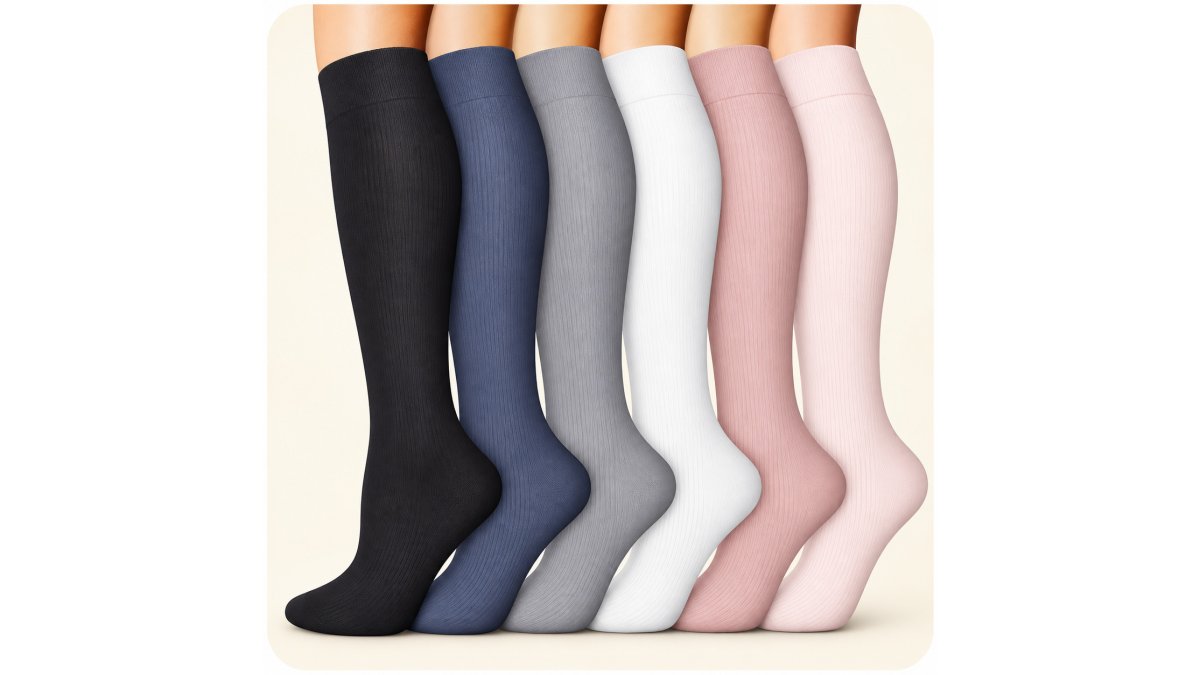
The 15-25 mmHg graduated compression sits in a supportive middle range: firmest at the ankle, easing as it climbs the calf.
What we like: the six-pair rotation means you're never stuck waiting on laundry before a long run, and the neutrals and patterns work under jeans or shorts.
Where it falls short: closed toes run warmer in summer, and 15-25 mmHg is more support than some casual wearers want.
2. All-Day Performance Compression Socks: Best for Long Training Blocks
Runners in a heavy training block need gear that survives repeated wear. The All-Day Performance Compression Socks 3-Pair Set at $29.99 is built for exactly that grind.

The design uses targeted stretch with a contoured, reinforced heel and cushioned footbed zones, heel friction and forefoot pressure are where cheap socks fail first.
This is our pick for runners who hike, cycle, or stand for hours on top of running, a genuine multi-use sock rather than a single-purpose one.
3. Everyday Ease 15-20 mmHg Open-Toe Compression Socks: Best for Warm Weather
Summer running creates a specific problem: full-coverage compression socks get hot. The Everyday Ease 15-20 mmHg Open-Toe Compression Socks 2-Pair Set solves it at $29.99.

The 15-20 mmHg graduated compression is slightly lighter than our top pick, suiting runners who find firmer socks restrictive.
Colors shown are black and beige, and the fit covers women and men. Two pairs per set means one on, one in the wash.
Honest limitation: open-toe socks can feel odd under tight running shoes, and some runners simply prefer full coverage for cold-weather runs.
Everyday Support 15–25 mmHg Knee-High Compression Socks — 6-Pair Set →
4. Compression Sleeves for Running Recovery and the Gear That Supports Them
Compression sleeves for running recovery cover the calf only, leaving the foot bare. That suits runners who want calf support but dislike the feel of a sock under their shoe, or who want to wear their own socks and add support on top. Sleeves are the least-discussed category in most gear guides, which usually split into socks-only or boots-only lists.
Socks vs. sleeves vs. boots: what each one actually does
- Compression socks cover the whole lower leg plus the foot and apply constant graduated pressure. They suit wearing during work, travel, or a run itself, and they are the simplest everyday option.
- Compression sleeves focus on the calf and leave the foot free. They are easy to layer over your own socks, easy to remove mid-run, and a good choice if you want calf support without changing your footwear setup.
- Pneumatic boots are a session, not a garment. They inflate chambers in sequence while you sit or lie down, and they are a bigger purchase aimed at dedicated recovery routines.
Socks are a state. The right pick depends on when and where you want support.
Matching the gear to your running scenario
- Marathon training block: a rotation of knee-high socks for daily wear.
- Travel and desk days: socks are the easiest win, constant support you can wear under jeans or trousers.
- Injury rehabilitation: talk to your clinician first. Compression can be part of a plan, but it is not a substitute for professional guidance.
What the evidence supports, and what it doesn't
Compression is best understood as a comfort tool. Many runners report less heavy legs after wearing it, and graduated pressure is a long-established construction in compression hosiery. What it won't do is replace sleep, hydration, nutrition, or easy days, the habits around your training matter far more than any single piece of gear. Treat socks as support for recovery, not a shortcut through it.
Layering and the gear that supports it
For carrying essentials on recovery walks or easy runs, the Unisex High-Visibility Running Waist Pack & Compression Storage Belt is our best seller; the snug compression fit stops bounce, and the reflective trim helps on early or late outings.
5. Best Compression Boots for Recovery: What Runners Should Know Before Buying
The best compression boots for recovery are pneumatic devices that wrap your legs in air chambers and inflate them in sequence to apply intermittent pressure. They're a bigger purchase than socks and do a different job: boots are used seated or lying down for a set session, not worn during a run. We don't sell boots, so this section helps you shop elsewhere with clear eyes, and shows where our socks fit alongside them.
How a boot session actually works
A typical pneumatic boot cycles through chambers from the foot or ankle upward, holds pressure briefly, then releases before the next chamber fills. Most units let you choose a pressure level and session length, and many offer a sequential or "wave" mode versus a uniform squeeze. The point isn't to crush your legs, it's a gentle, rhythmic push that supports circulation and reduces that heavy, swollen feeling after long efforts.
What to check before you buy
- Adjustable pressure, not a single setting. One pressure will not suit every leg on every day. Look for a range you can dial down on sore days and up after a marathon.
- Size by calf circumference, not shoe size. Boots that are too loose leak pressure; boots that are too tight are uncomfortable and can pinch. Measure your calf at its widest point and match the maker's chart.
- Battery life and cordless operation. A boot you have to plug in beside one specific chair gets used less. Check runtime per charge and whether it runs untethered.
- Session length and auto shut-off. Most sessions run in the 15-30 minute range. Auto shut-off matters if you tend to doze off mid-session.
Matching boots to your running scenario
For everyday soreness or desk-bound days, a rotation of compression socks is the simpler, lower-cost starting point, and most runners get more total use from socks than from a device that lives in the closet.
Where our gear fits
Our Everyday Support 15-25 mmHg Knee-High Compression Socks 6-Pair Set works well for that, and its graduated compression gives you support on the days you skip the boots entirely. If you prefer an open-toe feel under a boot liner, the Everyday Ease 15-20 mmHg Open-Toe Compression Socks 2-Pair Set is a lighter option.
How Compression Boots Work and Where Socks Fit In
Socks work differently. They apply constant graduated pressure all day, which is why they suit wearing during work, travel, or a run itself.
So which do you need? If your main complaint is tired legs during the day or after a run, socks are the simpler, cheaper starting point.
For most runners, a rotation of compression socks plus a couple of easy habits covers the recovery basics. To build a rotation, our Women's Lightweight Active Performance Low-Cut Socks 5-Pack at $15.99 handles training days, and our Cozy Merino Wool Hiking Socks 5-Pair Set at $34.99 covers cool-weather trail days.
Frequently Asked Questions
Is compression therapy good for runners?
Compression therapy is a popular recovery tool for runners because it applies gentle pressure to the legs, which many people find makes tired legs feel less heavy after long runs. The evidence is mixed on how much it speeds actual recovery, so treat it as a comfort aid rather than a performance booster. Graduated compression, where pressure is firmest at the ankle and eases upward, is the design to look for. Many runners wear compression socks during and after runs.
Are compression socks useful for recovery after running?
Many runners find compression socks useful after running because the snug fit feels supportive on tired legs. Socks in the 15-25 mmHg range, like our Everyday Support knee-high set, are a practical everyday option that also works for travel and long standing shifts. Put them on within an hour or two of finishing a run and wear them for a few hours. They are not a substitute for sleep, hydration, and easy days, but they are a low-cost addition to a recovery routine.
How should runners choose compression boots?
When shopping for the best compression boots for recovery, focus on chamber coverage, pressure settings, and how much space the unit takes up. Boots that cover the full leg give more coverage than calf-only sleeves, but they cost more and are harder to store. Check whether pressure is adjustable, since a single fixed setting rarely suits every leg. Battery life and wireless operation matter if you want to move around while wearing them. Set a budget first, then match features to how often you will actually use them.
How long should runners use compression recovery gear?
Most runners use compression socks for a few hours after a run, often through the evening. Start shorter and see how your legs feel. There is no single correct duration, and more time is not automatically better. If you feel numbness, tingling, or discomfort, take the gear off. Anyone with circulation problems or a diagnosed condition should check with a doctor before using compression gear regularly.
Do knee sleeves help with running recovery?
If knee pain persists beyond a day or two, see a doctor rather than relying on a sleeve to manage it.
Tired legs after a long training week are a familiar problem, and the fix doesn't have to be complicated or expensive. Dawterson has been curating practical everyday finds since 2017, and our compression socks are built for real rotation: a six-pair set with 15-25 mmHg graduated support, a three-pair performance option with reinforced heels, and an open-toe pair for warm weather. Explore the collection and build your box with free shipping on orders $50+ and 30-day no-hassle returns.
